
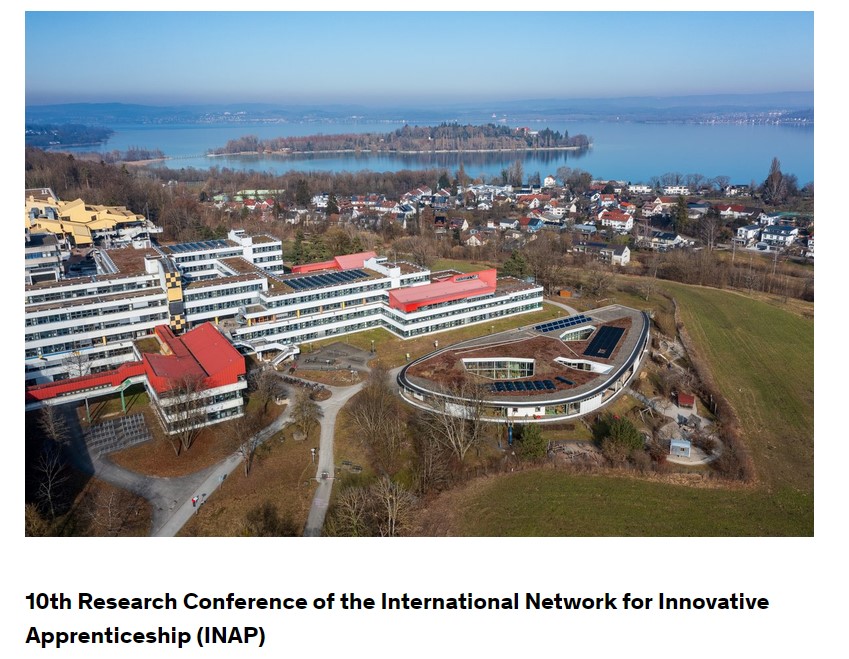
On 24–25 September 2026, Prof. Christian Imdorf, ProSkills2Work ERA Chair holder, and Prof. Rumiana Zheleva, DSc, Senior Researcher in the ProSkills2Work team at the Institute of Philosophy and Sociology at the Bulgarian Academy of Sciences (IPS-BAS), took part in the 10th Research Conference of the International Network on Innovative Apprenticeship (INAP). The conference was held at the University of Konstanz, Germany, under the theme “Apprenticeships: surviving, reviving, thriving”.
Twenty years of INAP
INAP was founded in 2006 as an international association of researchers and research institutions in vocational education and training (VET). Over two decades, it has become one of the main global forums for comparative research on apprenticeship. It brings together scholars, policymakers and practitioners from Europe, the Americas, Africa, Asia and Australia. This year’s jubilee conference included a special session looking back at twenty years of INAP conferences and papers. Keynote lectures were given by Stephen Billett (Griffith University) and Stephanie Allais (University of the Witwatersrand), and a panel brought together the ILO, the European Training Foundation, BIBB and SENAC. The conference closed with the farewell lecture of Prof. Thomas Deissinger (University of Konstanz) on the value of comparative VET research.
ProSkills2Work’s contribution
Prof. Imdorf chaired Session 2.1, where the team presented the paper “Dual apprenticeship transfer to Bulgaria: What role(s) do plural international stakeholders play for sustainable policy learning?”. The paper was co-authored by Christian Imdorf, Johannes Karl Schmees (TU Berlin / University of Derby) and Rumiana Zheleva.
The study looks at how elements of dual apprenticeship from Germany, Austria and Switzerland were transferred to Bulgaria with a special focus on the role of bi-national chambers of commerce in the policy implementation process. Since 2015, three loosely connected initiatives have supported dual-track VET in the country: those led by the German-Bulgarian Chamber of Industry and Commerce, the Swiss-funded DOMINO project, and the Austrian Federal Economic Chamber. Based on a multiple case study and expert interviews with Bulgarian and international stakeholders, preliminary findings show little planned top-down coordination between the initiatives but significant collaboration emerged among, and support from, bi-national chambers who act as intermediaries in the construction, expansion and maintenance of dual VET offerings in Bulgaria. The authors argue that understanding the complexity of multiple, parallel policy transfer initiatives is key to reforming Bulgarian VET and to making such reforms sustainable. The presentation drew on ongoing ProSkills2Work research on school-to-work transitions and skills formation in Bulgaria. It also strengthened the project’s links with the international VET research community.